
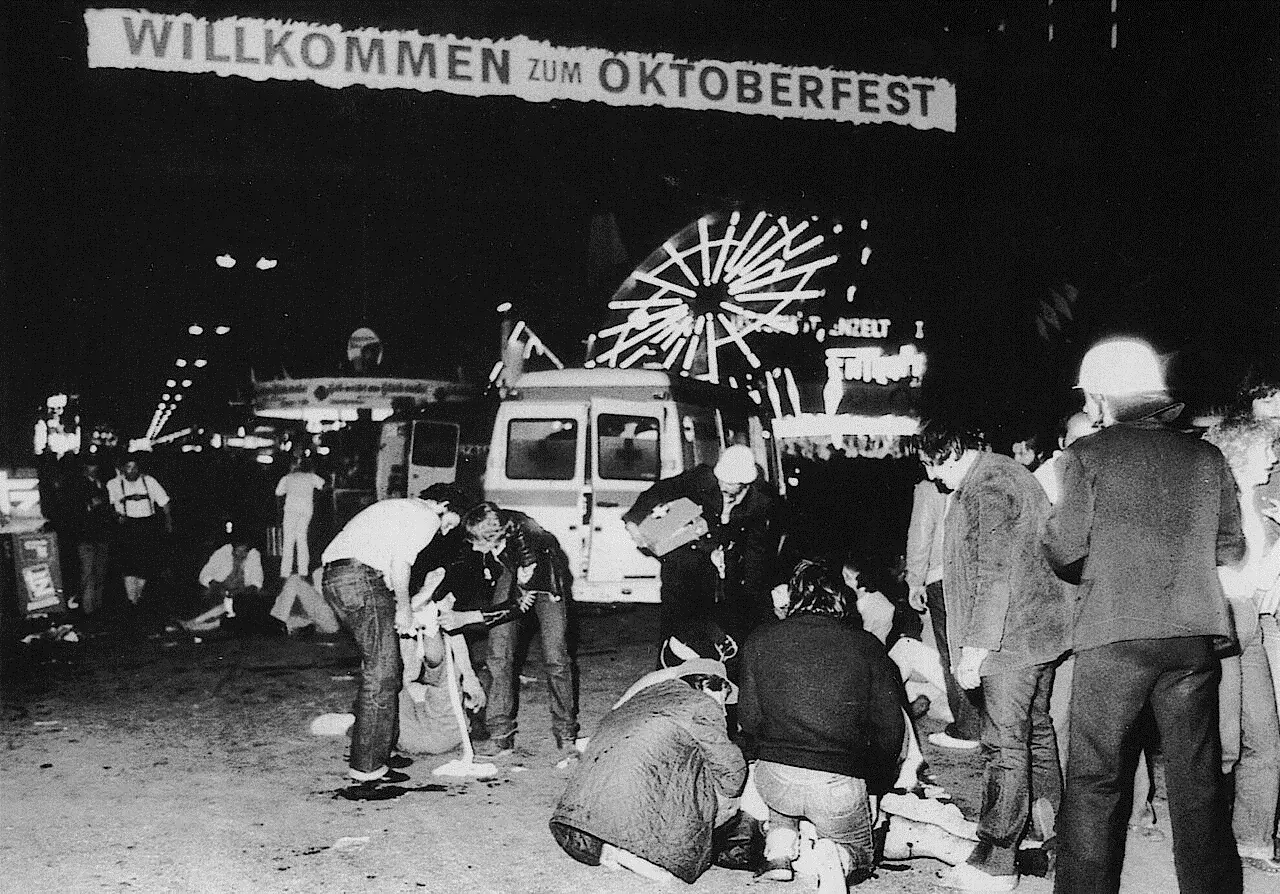
26 settembre 1980, 22.19. Una bomba esplode di fronte l’entrata dell’Oktoberfest. 13 morti, 211 feriti e i resti di un ordigno rudimentale: è il più grave attentato del dopoguerra in terra tedesca, per la cui paternità bisognerà attendere la sentenza del processo due anni più tardi.
A piazzare la granata è stato Gundolf Köhler, studente in Geologia. Identificato solo attraverso il passaporto che portava con sé, al momento del suo ritrovamento è irriconoscibile: troppo gravi le ferite dell’uomo, orribilmente sfigurato al volto e privo di entrambe le braccia. Gli sono bastati 1,39 chilogrammi di TNT, nascosti all’interno di un cestino per l’immondizia, per seminare morte alla 146° rassegna del festival. Gundolf ha riposto la bomba all’interno di un cilindro di metallo, riempito di viti e chiodi per rendere ancora più devastante lo scoppio.
Subito dopo l’attentato appare chiara, in mezza Europa, la matrice della strage. In Italia, due giorni dopo, L’Unità titola «La strage fascista a Monaco: 12 morti, molti feriti gravi»; Il Messaggero, sempre il 28 settembre, si domanda «Strage nazista?». Anche in Inghilterra, sulle pagine dell’autorevole The Times, si segue l’estrema destra: «La polizia tedesca arresta sei neo-nazisti dopo la morte del complice nell’esplosione di Monaco di Baviera». Una prima conferma arriva dallo studio del passato di Köhler: il ragazzo era infatti appartenente al gruppo neonazista "WehrSportgruppe Hoffmann”, letteralmente “Gruppo sportivo militare Hoffmann”, fondato nel 1973 da Karl-Heinz Hoffmann e sciolto dal governo tedesco nel 1980. Tre mesi dopo la strage, un altro membro della WehrSportgruppe uccide il rabbino di Erlangen, Shlomo Lewin, e sua moglie Frida Poeschke.
Il 23 novembre 1982 l’inchiesta della Procura federale e della polizia bavarese giunge alle sue conclusioni: Gundolf Köhler? Un lupo solitario. “Perché lo ha fatto?” Risentimento personale verso lo Stato. Dalla sentenza dell’alta Corte esce così il ritratto di uno studente depresso con una vita segnata da delusioni e relazioni fallimentari; un suicida.
Né più né meno. A dispetto di un’inchiesta del Der Spiegel, datata 6 ottobre 1980” e intitolata “W il fascismo. L’internazionale di estrema destra e neo nazista nei paesi europei”, che descriveva la rinascita e i collegamenti tra le destre di tutto il continente, per i giudici tedeschi non c’è stato alcun nesso politico.
Una nuova indagine durata dal 2014 al 2020 ha determinato che il motivo dell'autore era invece politico, ma la questione di altre persone coinvolte rimane irrisolta.
Fonti
EcoInternazionale.com
https://ecointernazionale.com/2019/09/26-settembre-1980-oktoberfest-si-tinge-di-sangue/
wikiwand.com
Strage di Monaco di Baviera del 1980 - Wikiwand
Approfondimenti
Il memoriale
Memoriale per le vittime dell'assassinio di Wiesn, Kreisfreie Stadt München Podcast - Loquis
da Spazio70
English version
On 26 September 1980 at 10:19 p.m., a bomb exploded in front of the entrance to the Oktoberfest. There were 13 deaths, 211 injured, and the remains of an improvised explosive device: it was the most serious post-war attack in German territory, for which it took the verdict of the trial two years later to determine responsibility.
The grenade was planted by Gundolf Köhler, a geology student. Identified only through the passport he was carrying, at the time of his recovery he was unrecognizable: the man’s injuries were too severe, his face horribly disfigured and both arms missing. He needed just 1.39 kilograms of TNT, hidden inside a rubbish bin, to sow death at the 146th edition of the festival. Gundolf had placed the bomb inside a metal cylinder filled with screws and nails to make the blast even more devastating.
Immediately after the attack, the far-right motivation behind the massacre became clear across half of Europe. In Italy, two days later, the newspaper L’Unità headlined “The fascist massacre in Munich: 12 dead, many seriously injured”; Il Messaggero, also on 28 September, wondered “Nazi massacre?” In England too, on the pages of the authoritative The Times, the far right was followed: “German police arrest six neo-Nazis after accomplice’s death in Munich bombing”. Initial confirmation came from a study of Köhler’s past: the young man was indeed a member of the neo-Nazi group “WehrSportgruppe Hoffmann” (literally “Military Sports Group Hoffmann”), founded in 1973 by Karl-Heinz Hoffmann and dissolved by the German government in 1980. Three months after the massacre, another member of the WehrSportgruppe killed the rabbi of Erlangen, Shlomo Lewin, and his wife Frida Poeschke.
On 23 November 1982 the investigation by the Federal Prosecutor’s Office and Bavarian police reached its conclusions: Gundolf Köhler? A lone wolf. “Why did he do it?” Personal resentment towards the State. The portrait emerging from the Higher Court’s verdict was that of a depressed student whose life was marked by disappointments and failed relationships; a suicide.
No more, no less. Despite an investigation by Der Spiegel dated 6 October 1980, titled “W for Fascism. The far-right and neo-Nazi international in European countries”, which described the resurgence and connections between right-wing groups across the continent, for the German judges there was no political connection.
A new investigation lasting from 2014 to 2020 determined that the perpetrator’s motive was political instead, though the question of other people’s involvement remains unresolved.
