
Dinamica dell’attentato
L’attentato avvenne alle 11:55 di sabato 9 ottobre 1982, giorno in cui si celebravano contemporaneamente lo shabbat, il bar mitzvah di alcune decine di adolescenti della comunità ebraica romana e lo Shemini Atzeret, a chiusura della festa di Sukkot. Si stima che nel Tempio fossero presenti almeno 300 persone, fra cui almeno una cinquantina di minorenni con le rispettive famiglie.
I cinque terroristi, vestiti in maniera elegante, camminarono con calma fino all’obiettivo. Tre si disposero in modo da poter bloccare tutte e tre le potenziali vie di fuga di Via Catalana, su cui si affaccia l’uscita posteriore della Sinagoga, mentre gli altri due si posizionarono davanti all’ingresso principale dell’edificio, posto su Via del Tempio. Secondo le ricostruzioni, un agente di sicurezza impiegato dalla comunità ebraica chiese a due componenti del commando di identificarsi. Questi risposero lanciando almeno tre bombe a mano e successivamente aprendo il fuoco con i mitra sulla folla. L’aggressione durò circa cinque minuti e successivamente gli attentatori furono visti fuggire a bordo di una Volkswagen rossa e di una Austin bianca.
L’unica vittima dell’attentato fu un bimbo di 2 anni, Stefano Gaj Taché, colpito a morte da una scheggia di una bomba a mano. 40 persone furono ferite, fra cui i genitori e il fratello della vittima, Gadiel Gaj Taché (4 anni), quest’ultimo colpito alla testa e all’addome.
Reazioni
L’attentato avvenne dopo cinque mesi dall’inizio della Guerra del Libano, un periodo in cui gli ebrei in ogni parte del mondo si trovavano sotto accusa per l’invasione israeliana del Libano meridionale e la comunità ebraica a Roma si sentiva attorniata da un clima ostile, in via Garfagnana era stato affisso uno striscione con la scritta «Bruceremo i covi sionisti» e una bara era stata deposta davanti la sinagoga durante un corteo della CGIL.
Subito dopo l’attacco, si registrarono reazioni durissime da parte della comunità ebraica: un giornalista de l’Unità fu costretto a rifugiarsi in un edificio vicino, insultato dalla folla. Sul posto arrivò subito l’allora Presidente del Consiglio Giovanni Spadolini a offrire la propria vicinanza all’allora Rabbino Capo della Comunità ebraica romana Elio Toaff. Spadolini fu accolto con favore dalla folla di presenti come l’unico, assieme a Marco Pannella a non aver ricevuto Arafat (con riferimento alla visita di qualche giorno prima del leader palestinese in Italia, che incontrò il Presidente della Repubblica Sandro Pertini, il sindaco di Roma Ugo Vetere e papa Giovanni Paolo II). Il rabbino Toaf invitò Pertini a non presenziare ai funerali.
Due giorni dopo l’attentato il consigliere comunale romano Bruno Zevi pronunciò un famoso discorso in Campidoglio (che venne pubblicato integralmente il giorno seguente sulle pagine del Tempo) a nome della Comunità Ebraica, davanti al sindaco di allora Ugo Vetere. Zevi parlò dell’antisemitismo diffuso, accusò il ministero degli Interni di «non aver apprestato dispositivi difensivi nel ghetto e intorno alla sinagoga, malgrado fossero stati insistentemente richiesti» notando un’Italia «che manda i suoi bersaglieri in Libano per proteggere i palestinesi, ma non protegge i cittadini ebrei italiani», criticò il Vaticano «per il modo pomposo in cui ha ricevuto Arafat», i politici e i media «che salvo rare eccezioni hanno distorto fatti e opinioni». Alla fine del suo discorso Zevi disse: «L’antisemitismo è esistito per duemila anni, non dal 1948, dalla proclamazione dello Stato d’Israele. Non crediamo all’antisionismo filosemita: è una contraddizione in termini».
Indagini
Nei giorni successivi all’attentato, l’atto venne attribuito al Consiglio rivoluzionario di al-Fath guidato da Abu Nidal, responsabile di numerosi attentati contro obbiettivi ebraici in Italia e in Europa lungo gli anni ottanta. Una rivendicazione da parte di sedicenti “Brigate Rosse OLP” non fu giudicata attendibile dagli inquirenti.
A oggi si conosce l’identità solo di uno degli attentatori, Osama Abdel Al Zomar, arrestato il 20 novembre 1982 mentre cercava di passare il confine fra Grecia e Turchia portando con sé un carico di esplosivo. In seguito all’arresto, ulteriori riscontri condotti dalla polizia e la testimonianza della sua fidanzata italiana portarono a identificarlo come uno dei componenti del commando.
Al Zomar scontò una condanna per traffico di armi in Grecia, al termine della quale, nonostante le richieste di estradizione avanzate dall’Italia, fu lasciato libero. Zomar riparò in Libia, dove risulta sia rimasto fino alla caduta del regime di Gheddafi. Nel 1991 fu condannato in contumacia per strage dalla Corte d’Appello di Roma.
Uno dei principali collaboratori di Abu Nidal fu arrestato in Svizzera nel mese di settembre (quindi prima dell’attentato), ma la notizia fu resa nota solo a metà ottobre, perché si sospettò che l’arrestato fosse fra gli ideatori di questo e altri attacchi contro luoghi e istituzioni ebraiche
Fonte
Wikipedia
Attentato alla Sinagoga di Roma
Approfondimenti
Moked
Mattarella ricorda Stefano Taché: “Un bambino italiano”
Memorie Ebraiche
NOI, POPOLO DI ISRAELE, PROTESTIAMO E ACCUSIAMO – Bruno Zevi da: Il Tempo, 11 ottobre 1982
Il Riformista
Attentato alla Sinagoga di Roma, il governo sapeva ma non fece nulla – I DOCUMENTI SEGRETI
La Stampa
Video
Corriere della Sera
Attentato sinagoga Roma, la mamma del piccolo Stefano Gaj Taché ucciso nel 1982: «Chiediamo…
Radio Radicale
Rai Play
Sorgente di vitaMio fratello Stefano (attentato sinagoga di Roma)
Il Libro
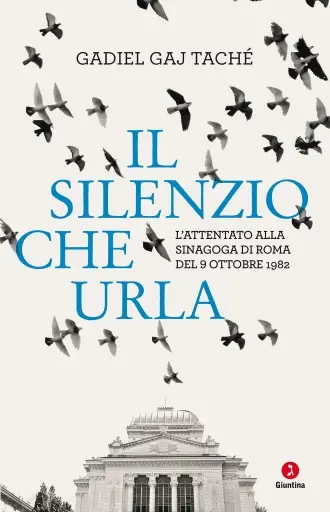
Il silenzio che urla – Giuntina
Immagini
Archivio Luce
Attentato alla sinagoga di Roma
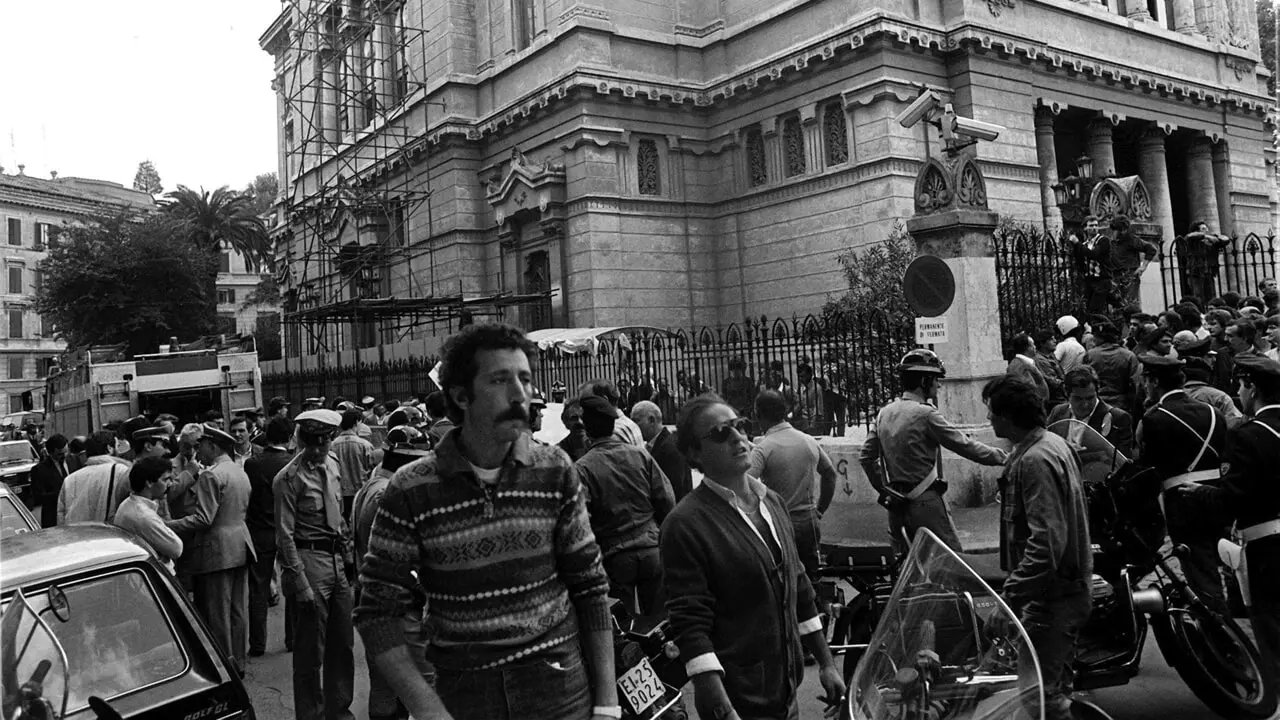
da RomaToday
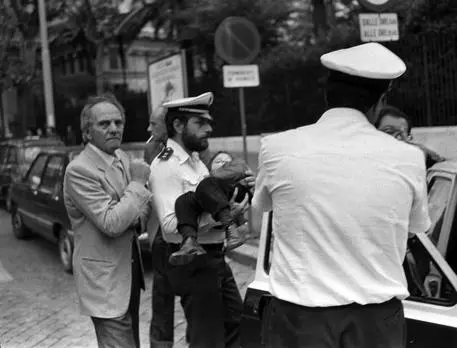
da Ansa
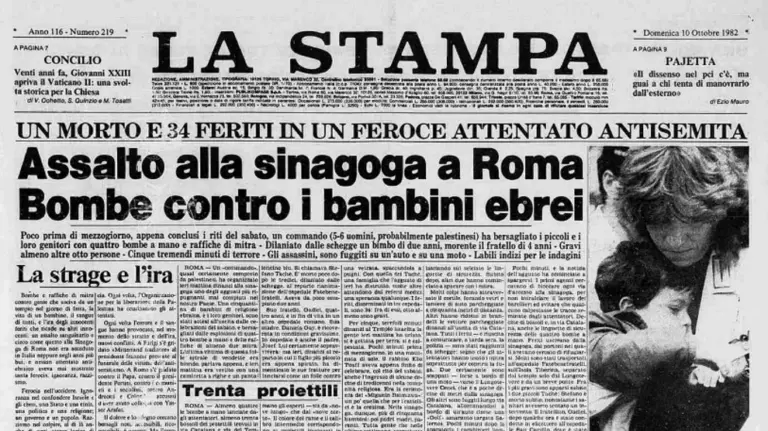
da La Stampa
English version
Stefano Gaj Taché, 2 years old
Dynamics of the attack to the Synagogue of Rome
The attack occurred at 11:55 AM on Saturday, October 9, 1982, a day when Shabbat, the bar mitzvah of several dozen teenagers from the Roman Jewish community, and Shemini Atzeret, marking the end of the Sukkot festival, were being celebrated simultaneously. It is estimated that at least 300 people were present in the Temple, including at least fifty minors with their families.
The five terrorists, dressed elegantly, walked calmly to their target. Three positioned themselves to block all three potential escape routes on Via Catalana, which faces the rear exit of the Synagogue, while the other two positioned themselves in front of the main entrance of the building, located on Via del Tempio. According to reconstructions, a security guard employed by the Jewish community asked two members of the commando to identify themselves. They responded by throwing at least three grenades and then opening fire with submachine guns on the crowd. The attack lasted about five minutes, after which the assailants were seen fleeing in a red Volkswagen and a white Austin.
The only victim of the attack was a 2-year-old boy, Stefano Gaj Taché, who was fatally struck by shrapnel from a grenade. Forty people were injured, including the victim’s parents and his brother, Gadiel Gaj Taché (4 years old), who was hit in the head and abdomen.
Reactions
The attack occurred five months after the start of the Lebanon War, a period during which Jews worldwide were under accusation for the Israeli invasion of southern Lebanon, and the Jewish community in Rome felt surrounded by a hostile atmosphere. In Via Garfagnana, a banner reading “We will burn Zionist nests” had been posted, and a coffin was placed in front of the synagogue during a CGIL march.
Immediately after the attack, there were harsh reactions from the Jewish community: a journalist from l’Unità had to take refuge in a nearby building, insulted by the crowd. Then Prime Minister Giovanni Spadolini arrived on the scene to offer his support to the then Chief Rabbi of the Roman Jewish Community, Elio Toaff. Spadolini was welcomed by the crowd as the only one, along with Marco Pannella, not to have received Arafat (referring to the recent visit of the Palestinian leader to Italy, where he met President Sandro Pertini, the mayor of Rome Ugo Vetere, and Pope John Paul II). Rabbi Toaf invited Pertini not to attend the funerals.
Two days after the attack, Roman city councilor Bruno Zevi delivered a famous speech at the Campidoglio (published in full the next day in Il Tempo) on behalf of the Jewish Community, in front of then-mayor Ugo Vetere. Zevi spoke of widespread anti-Semitism, accused the Ministry of the Interior of “not having set up defensive measures in the ghetto and around the synagogue, despite persistent requests,” noting an Italy “that sends its bersaglieri to Lebanon to protect the Palestinians but does not protect Italian Jewish citizens,” and criticized the Vatican “for the pompous way in which it received Arafat,” politicians, and the media “who, with few exceptions, distorted facts and opinions.” At the end of his speech, Zevi said: “Anti-Semitism has existed for two thousand years, not since 1948, from the proclamation of the State of Israel. We do not believe in philo-Semitic anti-Zionism: it is a contradiction in terms.”
Investigations
In the days following the attack, the act was attributed to the Abu Nidal-led Revolutionary Council of Fatah, responsible for numerous attacks against Jewish targets in Italy and Europe throughout the 1980s. A claim by self-proclaimed “Red Brigades PLO” was not deemed credible by investigators.
To date, only one of the attackers’ identities is known, Osama Abdel Al Zomar, who was arrested on November 20, 1982, while trying to cross the border between Greece and Turkey carrying a load of explosives. Following his arrest, further checks conducted by the police and testimony from his Italian girlfriend identified him as a member of the commando.
Al Zomar served a sentence for arms trafficking in Greece, at the end of which, despite Italy’s extradition requests, he was released. Zomar took refuge in Libya, where he remained until the fall of Gaddafi’s regime. In 1991, he was convicted in absentia for massacre by the Court of Appeal of Rome.
One of Abu Nidal’s main collaborators was arrested in Switzerland in September (before the attack), but the news was made public only in mid-October, as it was suspected that the detainee was among the masterminds of this and other attacks against Jewish sites and institutions.
